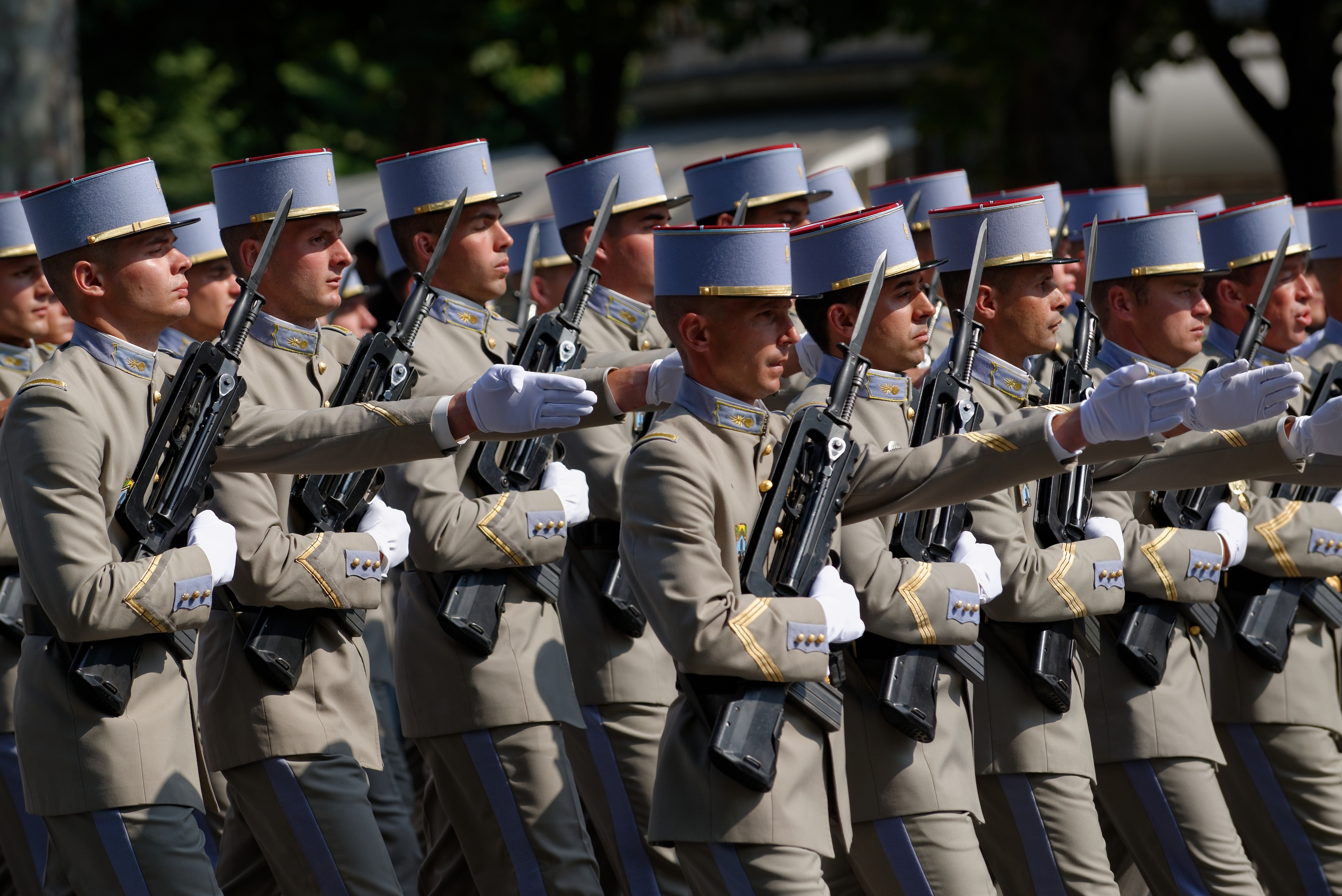
President Emmanuel Macron reviewed troops during his final Bastille Day military parade as president of France on Tuesday in Paris [1, 2].
The event served as a critical demonstration of France's re-armament and Europe's strategic autonomy during a period of continued Russian aggression against Ukraine [1, 3].
Marching along the Champs-Élysées between the Arc de Triomphe and Place de la Concorde, the parade featured a massive display of military hardware and personnel [1, 2]. Estimates of the total number of participants vary across reports, ranging from over 6,000 troops [1] to nearly 6,700 [3], with some reports stating 7,000 people marched in total [4].
Among the participants were 500 coalition troops, highlighting the international cooperation and solidarity intended to support Ukraine [1]. The aerial display included 98 aircraft and 31 helicopters [3]. On the ground, the procession included 315 vehicles [3].
This military exhibition marks the end of an era for Macron's presidency. By integrating European allies into the national celebration, the French government aimed to showcase a unified continental front. The scale of the event reflects a broader shift toward increased defense spending and military readiness across the region [3, 5].
French officials used the platform to emphasize the necessity of a self-reliant European defense architecture. The presence of allied forces on the Champs-Élysées was designed to transform a traditional national holiday into a statement of geopolitical resolve [2, 3].
“Macron reviewed troops during his final Bastille Day military parade as president of France”
The scale and composition of this final parade under Macron signify a pivot in French foreign policy toward 'strategic autonomy.' By blending national celebration with a coalition of European forces, France is signaling that its security interests are now inextricably linked to the broader stability of the European continent and the defense of Ukraine.


