
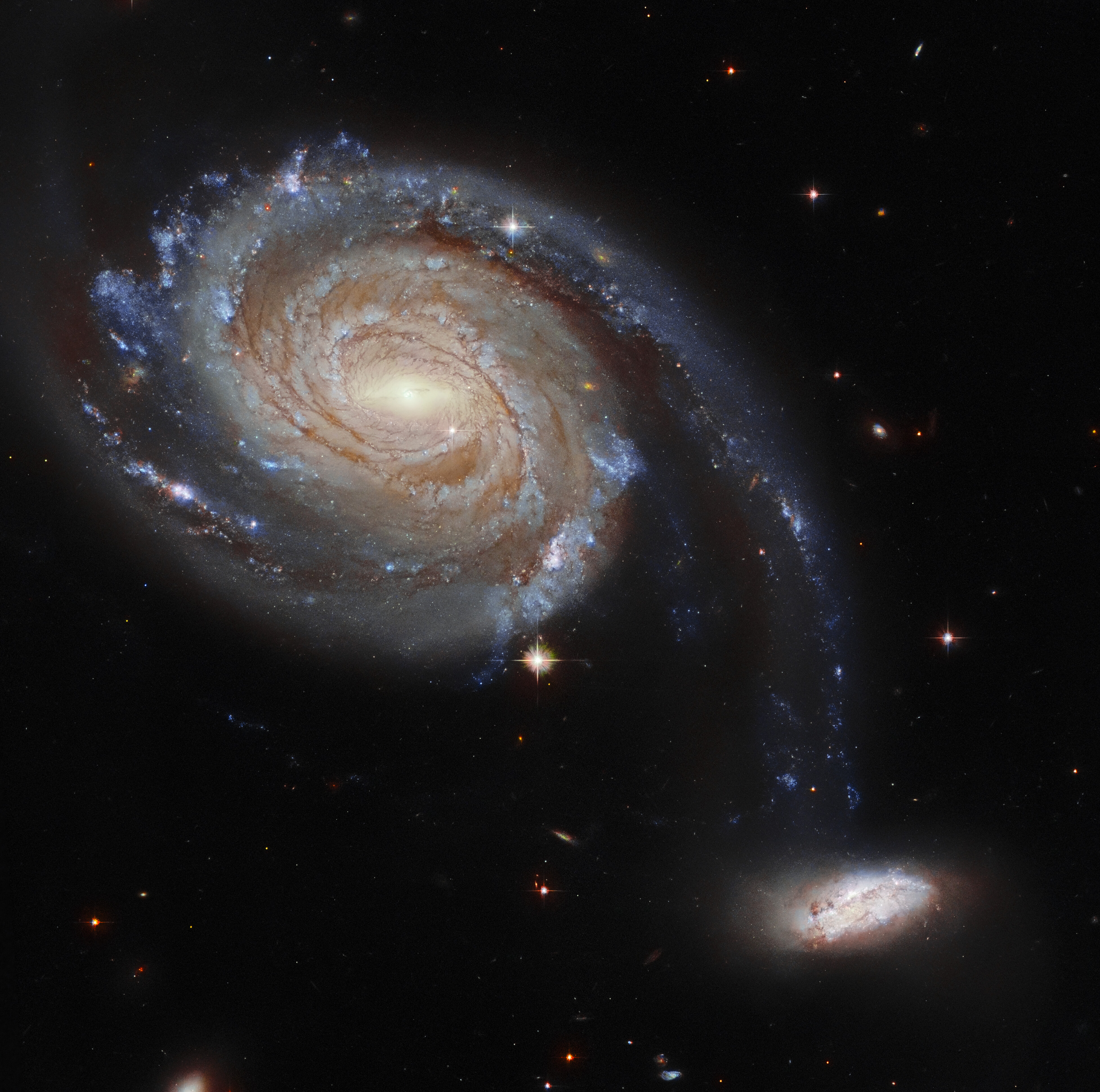
NASA's James Webb Space Telescope captured an image of the bright core of galaxy M77 on May 7, 2026 [1].
The image provides a detailed look at the interaction between a supermassive black hole and the surrounding galactic material. By isolating the heat and light emitted from the center of the galaxy, astronomers can better understand how gravity shapes the evolution of spiral galaxies.
Located in the constellation Cetus, M77 sits approximately 45 million light-years from Earth [2]. The telescope's Mid-Infrared Instrument, known as MIRI, was used to pierce through cosmic dust to reveal the galaxy's structure. The resulting image highlights swirling spiral arms, and the dust within the galactic disk [3].
At the center of M77, gas is pulled by the strong gravity of a central black hole into a tight and rapid orbit [1]. The friction generated by this process heats the gas, causing it to radiate intense light [1]. This phenomenon creates the effect of a "beacon of light in swirls of dust," the NASA team said [4].
"This new image from Webb's Mid-Infrared Instrument (MIRI) highlights its swirling spiral arms, the dust in its disk and its piercingly bright core like never before," the NASA Webb team said [3]. The team said that gas rapidly orbits the central black hole, heating up and radiating light [3].
Because the MIRI instrument detects mid-infrared light, it can see through the thick dust that often obscures the centers of galaxies in visible-light photography. This allows researchers to observe the accretion process, the method by which a black hole consumes nearby matter, with unprecedented clarity [1].
“a beacon of light in swirls of dust”
The ability to observe the core of M77 in the mid-infrared spectrum allows scientists to study the physics of accretion disks without interference from interstellar dust. This data helps refine models of how galactic nuclei influence the star formation and structural stability of the rest of the galaxy.


