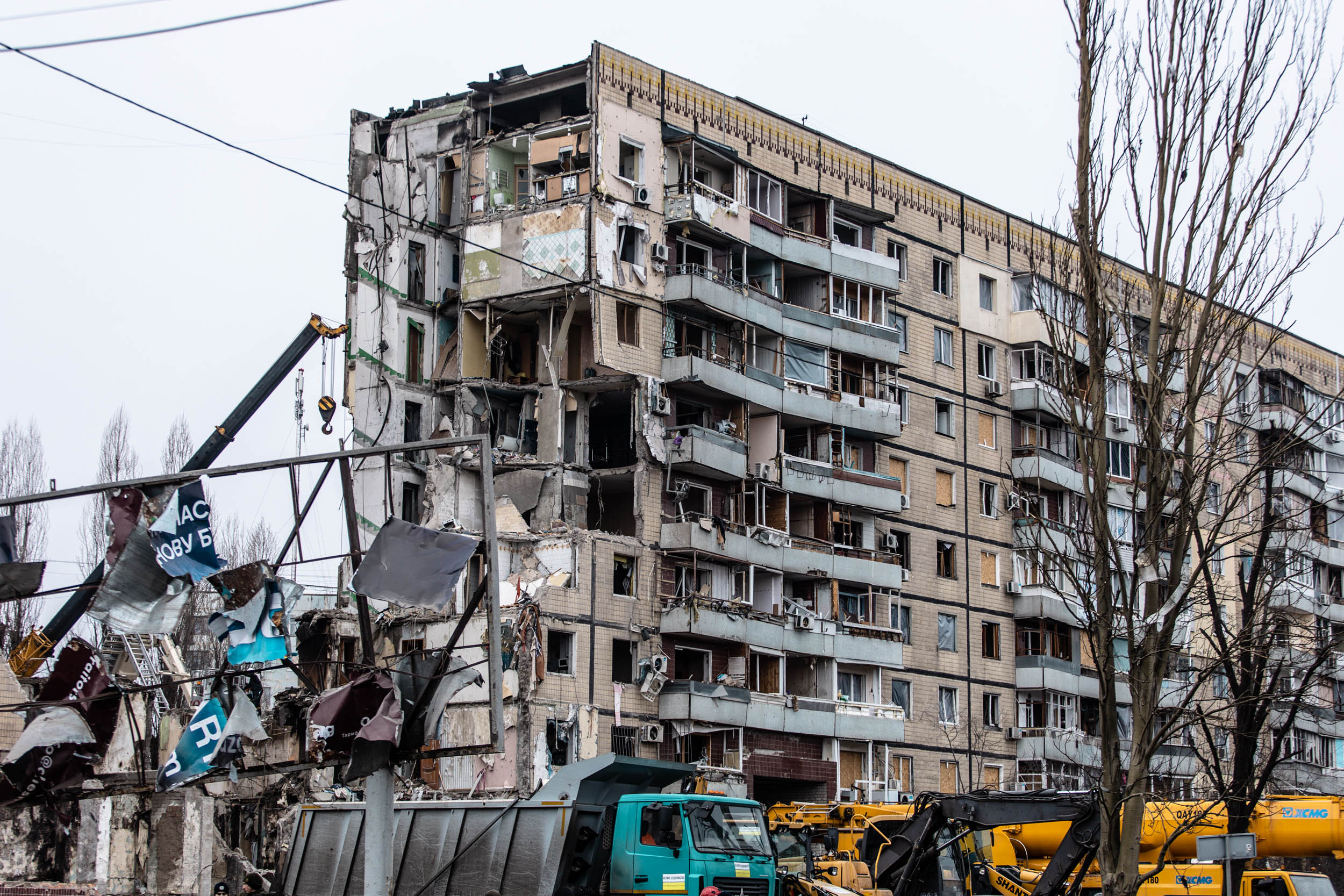
Russian forces launched a massive wave of missiles and drones against Kyiv and other Ukrainian cities on Sunday [1, 2, 3].
These strikes underscore the continued vulnerability of Ukrainian urban centers to large-scale aerial bombardments despite the presence of advanced air defense systems.
According to reports, the Russian military deployed 659 drones and 44 missiles within a 24-hour period [1]. The Ukrainian Air Force said it intercepted 636 of the drones and 31 of the missiles [1]. Despite these interceptions, several strikes successfully hit targets in the capital city of Kyiv, as well as in Odesa and Dnipro [2, 3].
Casualty reports vary across sources. One report said that at least 16 people died [1], while another report cited a minimum of 13 deaths [2]. The strikes targeted various areas across the three cities, causing significant casualties and damage to infrastructure [1, 2].
Ukrainian defense forces continued to operate air defense systems throughout the day to mitigate the impact of the incoming munitions [1]. The scale of the drone deployment—totaling over 600 units—represents a concentrated effort to overwhelm the Ukrainian airspace [1].
Local authorities in Kyiv and Odesa have been coordinating emergency responses to assist those affected by the blasts. The coordination between the Air Force and ground-based defense units remains the primary line of protection against these recurring aerial assaults [1, 3].
“Russian forces launched a massive wave of missiles and drones against Kyiv and other Ukrainian cities”
The high volume of drones launched compared to the number of missiles suggests a strategy of saturation, intended to exhaust Ukrainian air defense interceptors and create gaps for more lethal missile strikes. While the interception rate for drones remains high, the loss of 13 to 16 lives indicates that even a small percentage of successful hits in densely populated areas like Kyiv, Odesa, and Dnipro results in significant civilian casualties.