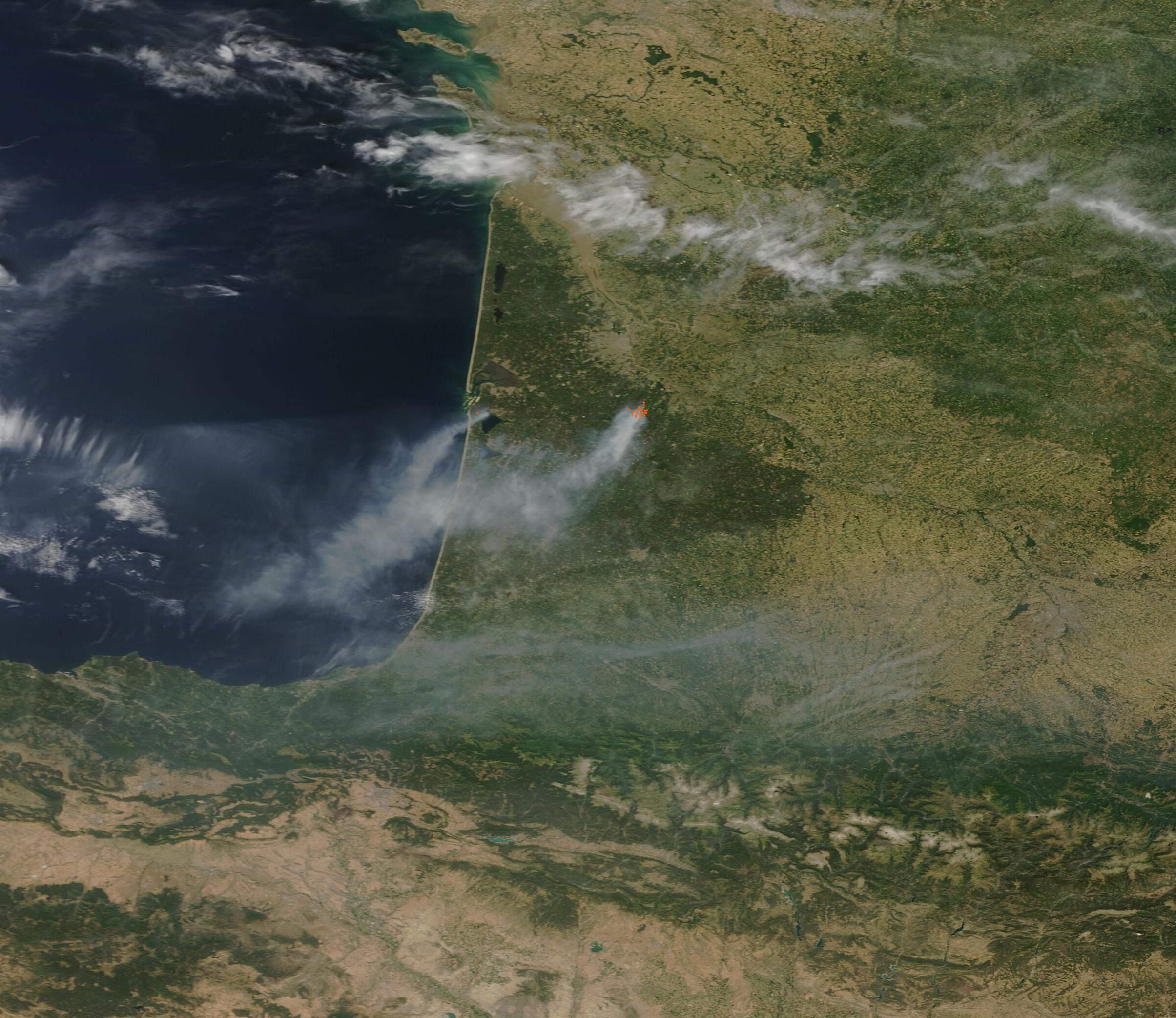
More than 20,000 residents and visitors were evacuated in France on Thursday as violent forest fires swept through the southwest [1].
These evacuations highlight the increasing volatility of European summers, where extreme weather conditions are fueling destructive blazes that threaten both human life and critical ecosystems.
The fires concentrated in the Gironde department, specifically near the Arcachon basin [3, 4, 5]. Emergency services struggled to contain the flames, which at one point moved within 300 meters of residential homes [5]. The speed of the fire was amplified by unfavorable meteorological conditions, including high heat, dry air, and strong winds [6].
The human cost of the current fire season has risen with the deaths of three firefighters [2]. Two of the casualties died while fighting the blazes in France, and one died in Italy [2].
Reports on the scale of the destruction in Gironde vary. France 24 said that 2,400 hectares were ravaged [4]. However, other sources indicate a higher toll, with MSN reporting more than 3,000 hectares burned [6] and La Chaîne Météo specifying a figure of 3,100 hectares [3].
While France remains the primary focus of current emergency efforts, the crisis is not isolated. Similar wildfires have broken out across Spain and Italy, signaling a broader regional emergency across Southern Europe [2, 3].
“More than 20,000 residents and visitors were evacuated in France”
The simultaneous occurrence of devastating fires in France, Spain, and Italy suggests a systemic vulnerability to heat-driven disasters in Southern Europe. The discrepancy in reported acreage—ranging from 2,400 to 3,100 hectares—reflects the difficulty of assessing damage in real-time during active evacuations and rapid fire spread.


