
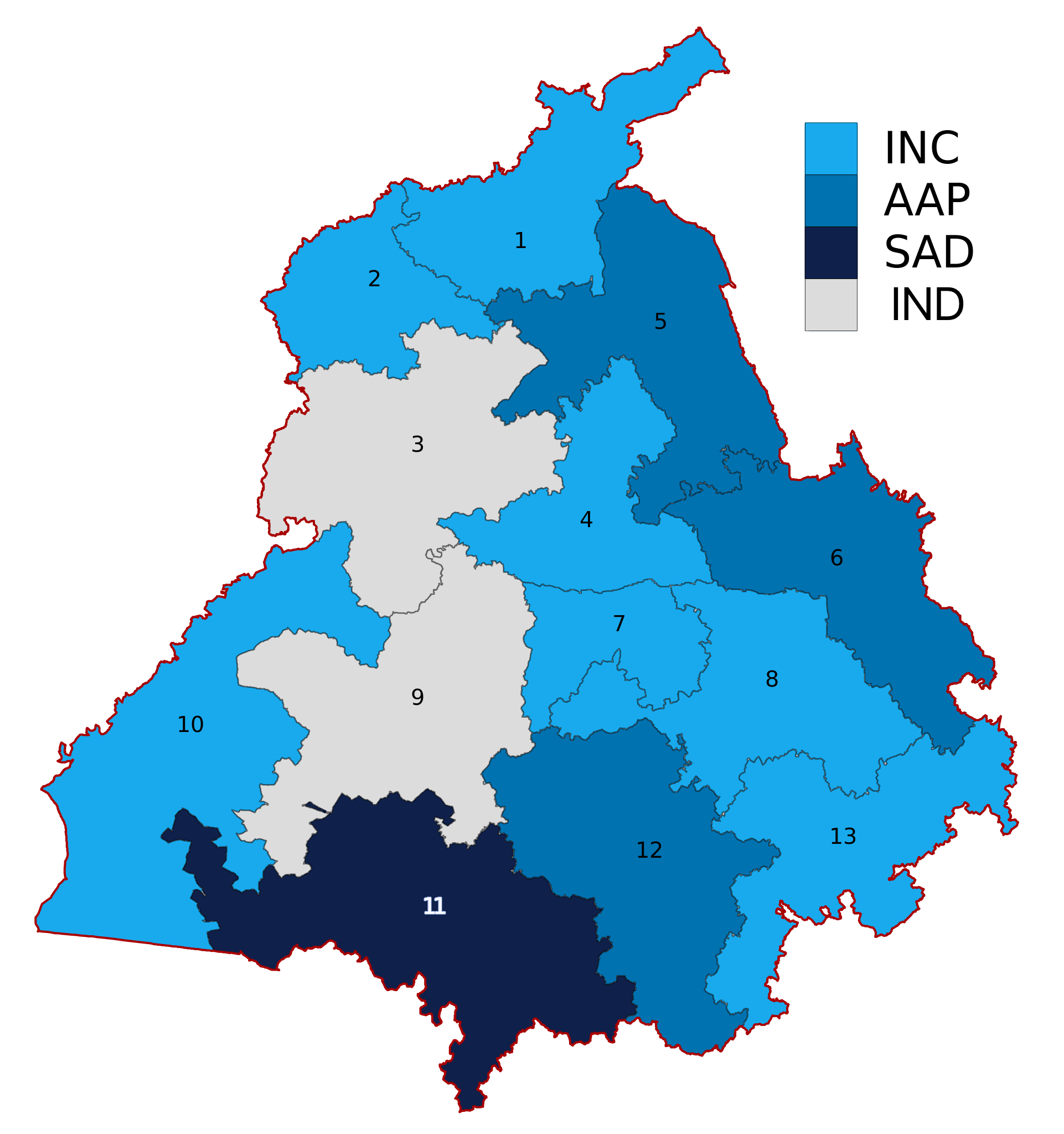
The Aam Aadmi Party (AAP) secured more than 690 wards in the Punjab civic body elections [1].
This result establishes a dominant local government presence for the party across the state. By securing a vast number of urban local bodies, AAP gains significant control over municipal administration and resource allocation in key districts.
The party crossed the 900-seat mark overall during the counting process [2]. These results span 102 municipal bodies across Punjab [1]. Out of the 1,897 total contested wards, AAP secured over 690 [1].
Observers said there was a particular breakthrough for the party in the Sangrur district [2]. This specific regional success contributed to the party's overall momentum in the civic polls.
The victory gives AAP a decisive edge over its primary political rivals, including the Congress, the Bharatiya Janata Party (BJP), and the Shiromani Akali Dal (SAD) [1]. The results reflect a strong campaign and significant voter support within urban local bodies [1].
Counting for the municipal elections took place on March 5, 2026 [1]. The party's ability to translate its state-level popularity into local ward victories suggests a consolidation of power at the grassroots level, a move that complicates the efforts of opposition parties to regain a foothold in the region [3].
“AAP crossed the 900-seat mark”
The scale of this victory indicates that the Aam Aadmi Party has successfully expanded its influence from the state legislature into the granular level of municipal governance. By dominating 102 municipal bodies, the party can now implement its policy agenda more directly at the local level, potentially marginalizing the opposition's influence in urban centers across Punjab.


