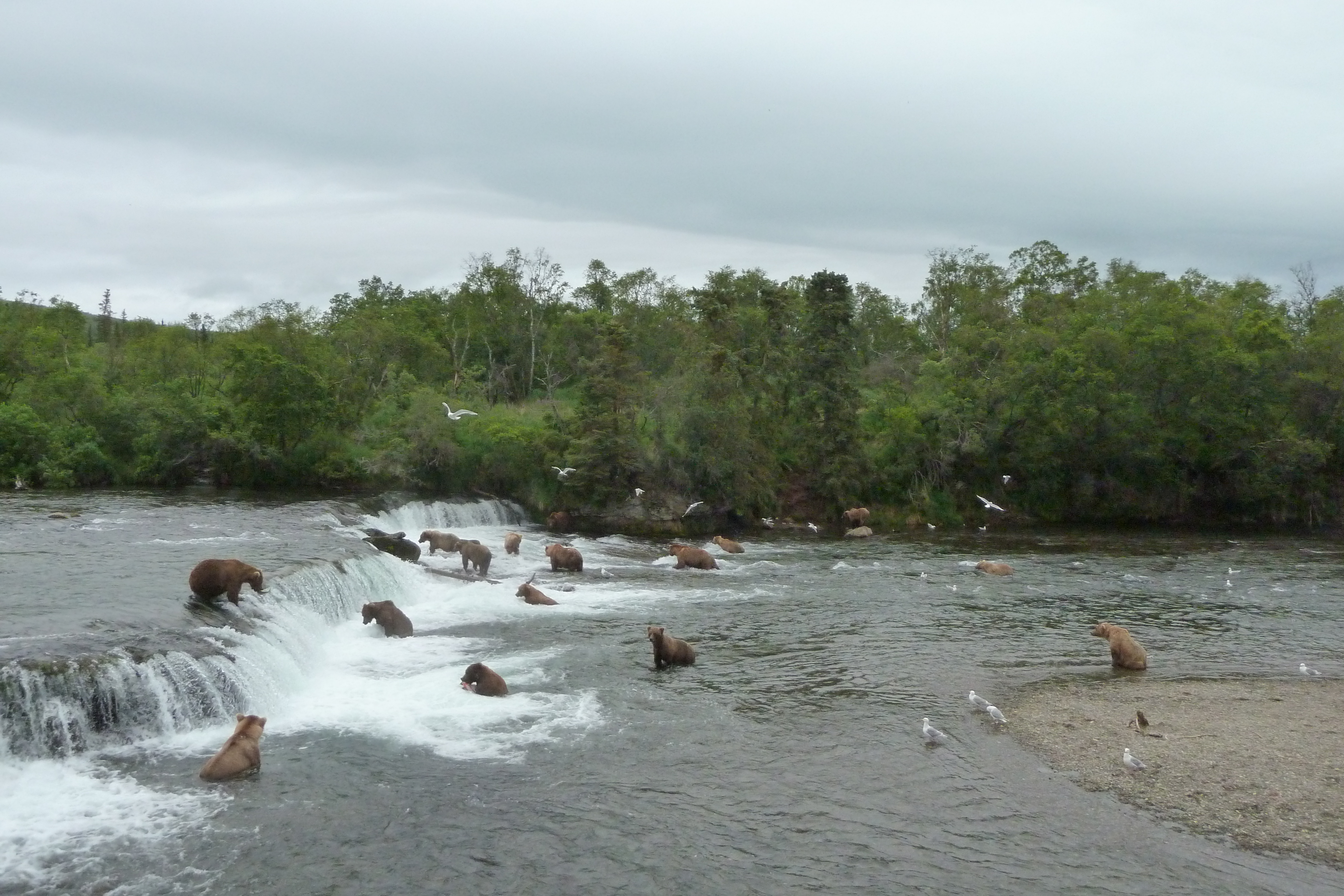
Brown and grizzly bears are congregating at Brooks Falls in Katmai National Park and Preserve to feast on salmon [1].
This seasonal feeding behavior is critical for the animals' survival. The bears must consume massive quantities of fish to build the fat reserves necessary to endure winter hibernation [1, 3].
Katmai National Park ranger Troy Hunt said he has observed the bears during this period [1]. The activity peaks in July [2], which serves as the prime month for salmon feeding [2]. To document the behavior, a livestream of the falls began on June 23, 2023, at 11 a.m. ADT [2].
The scale of the gathering is significant. Observers have seen as many as 40 bears at the falls at one time [2]. This concentration of predators is driven by the abundance of fish navigating the falls, providing a high-calorie food source that allows the bears to bulk up quickly.
Located in the U.S. state of Alaska, Brooks Falls is a well-known site for this natural phenomenon. The bears use the falls as a strategic hunting ground, waiting for salmon to leap upward, a process that provides the bears with easy access to nutrient-dense prey.
Wildlife officials monitor these patterns to ensure the health of the bear population. The ability of the bears to successfully hunt during these summer months directly impacts their ability to survive the coming winter months when food sources disappear.
“Bears are feasting on salmon to bulk up before winter hibernation”
The congregation of bears at Brooks Falls illustrates the interdependence between salmon migration and apex predator survival. Because brown bears rely on these high-protein windows to survive hibernation, any disruption to salmon populations—due to environmental changes or human interference—could directly threaten the stability of the Katmai bear population.


