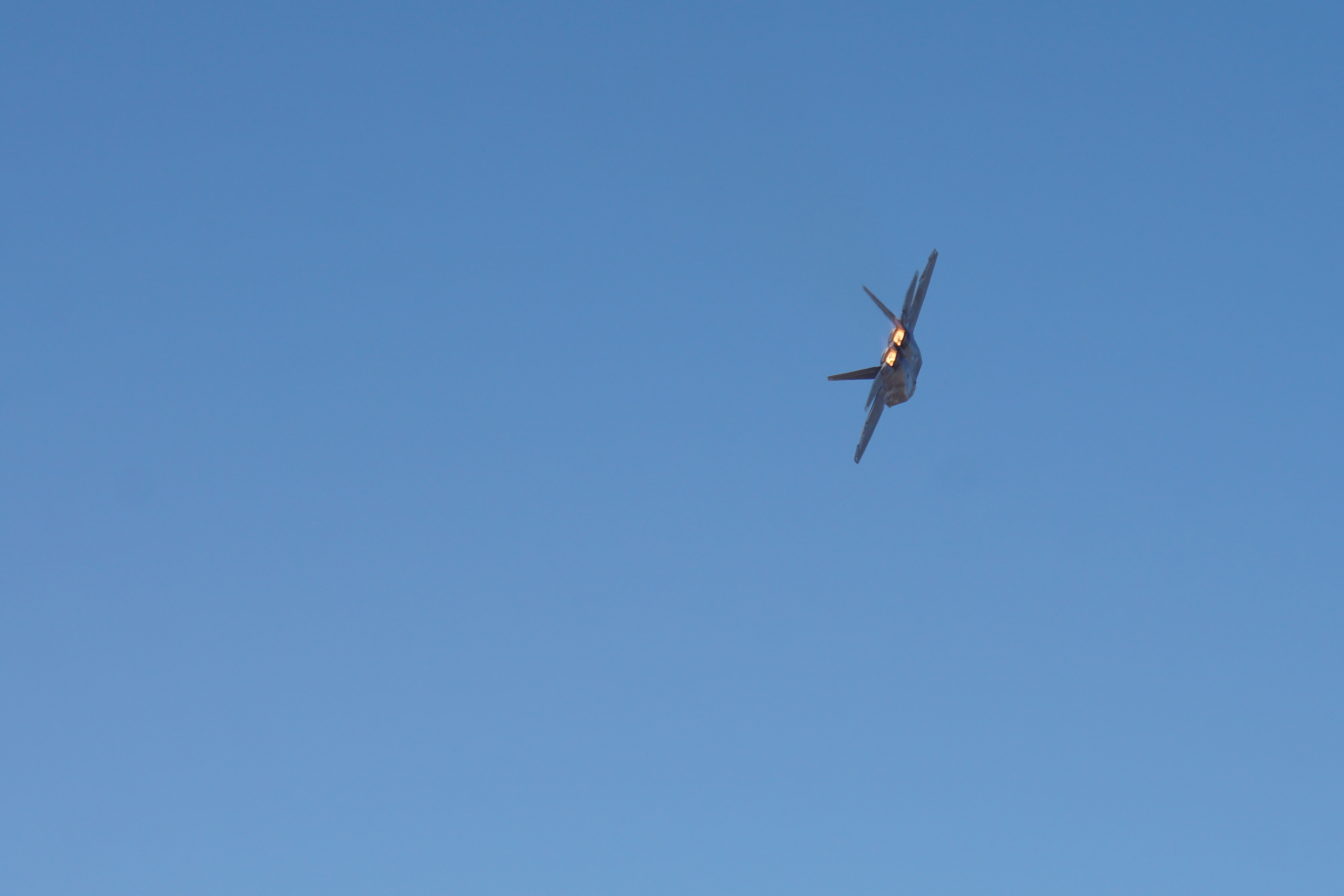
The outward-canted tail fins of the F-22 Raptor redirect radar energy away from enemy sensors to reduce the aircraft's radar reflections [1].
This specific design choice is critical for maintaining the low-observable profile required for fifth-generation fighters to operate in contested airspace. By lowering the radar cross-section, the U.S. Air Force can deploy the aircraft in environments where traditional fighters would be easily detected.
Lockheed Martin engineers developed the angled fins during the aircraft's development in the early 1990s [2]. The design focuses on reducing "glint," which occurs when radar waves bounce directly back to a receiver. By angling the surfaces, the energy is scattered in different directions, making the plane harder to track on radar screens [1, 2].
Beyond stealth, the tail configuration serves a mechanical purpose. The canted fins aid directional control and stability during high-angle maneuvers [1, 2]. This allows the pilot to maintain control during aggressive combat turns or steep climbs without sacrificing the aircraft's stealth properties.
"The F‑22 Raptor’s outward tilted tail fins are a crucial part of its low observable design," a WION Podcast host said.
The aircraft first flew on Sept. 7, 1997 [2]. Since then, the Raptor has served as a primary asset for defending U.S. carrier groups in the Western Pacific and countering other stealth fighters in the South China Sea [1, 3].
The integration of these fins demonstrates the balance between aerodynamics and electronic warfare. While vertical stabilizers are standard for stability, the Raptor's deviation from that norm allows it to remain invisible to many legacy radar systems while maintaining superior agility in the air.
“The F‑22 Raptor’s outward tilted tail fins are a crucial part of its low observable design.”
The F-22's tail design represents a fundamental shift in aerial combat, where the ability to remain undetected is as important as speed or weaponry. By prioritizing radar deflection through geometry, the U.S. established a benchmark for stealth that subsequent aircraft must either mimic or find ways to counter using advanced sensor technology.


