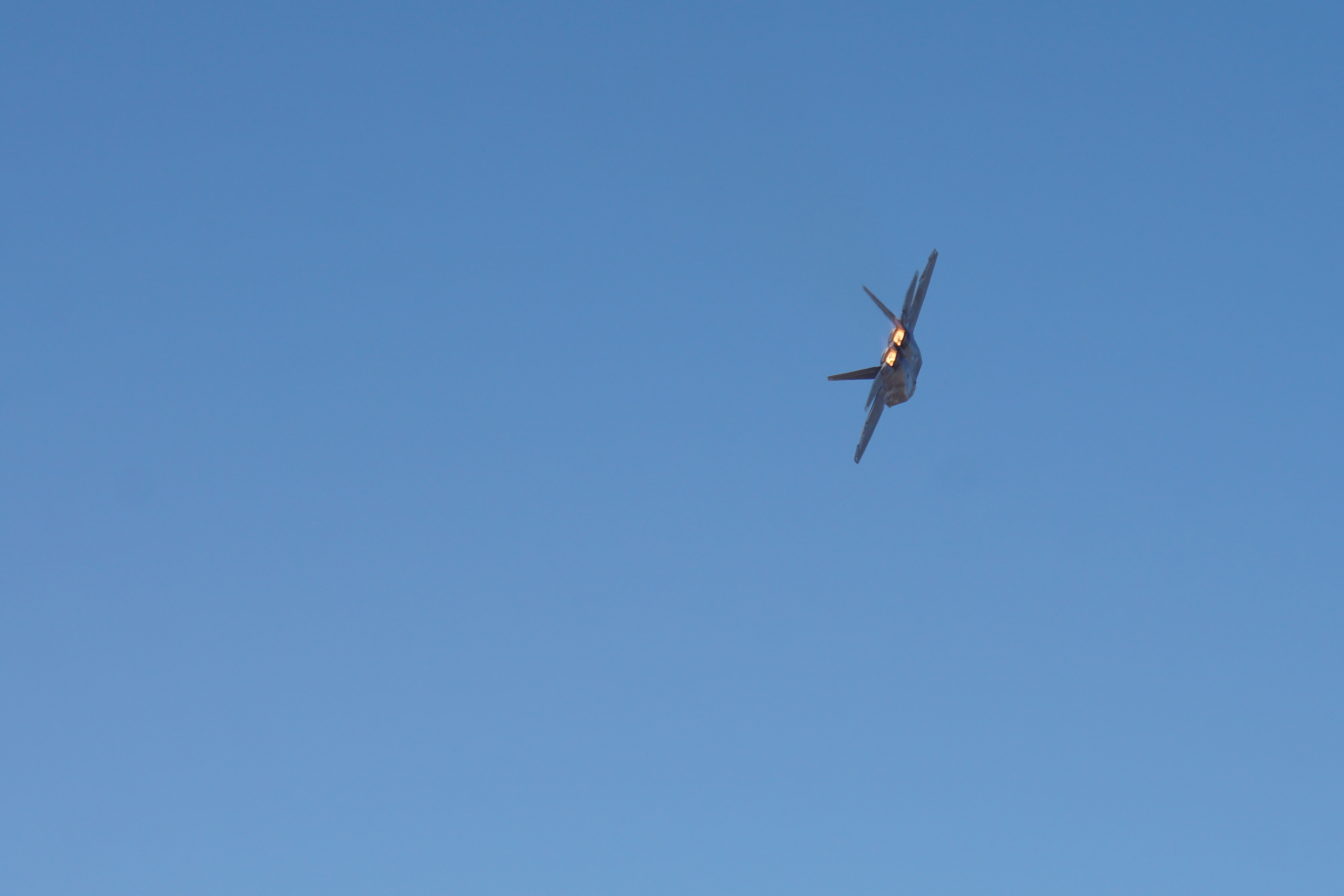
The Lockheed Martin F-22 Raptor remains the central pillar of U.S. air power due to its stealth and advanced sensor fusion [1, 2].
This continued dominance is critical as the U.S. Air Force deploys these aircraft across the Indo-Pacific region to maintain a strategic edge over adversaries [2]. The aircraft's ability to operate undetected while engaging targets ensures that the U.S. retains air superiority in contested environments.
First operational in 2005, the F-22 utilizes a combination of stealth shaping and supercruise—the ability to maintain supersonic speeds without afterburners—to outmaneuver opposing forces [2]. The aircraft also employs thrust-vectoring and sensor-fusion to integrate data from multiple sources into a single tactical picture [1].
Recent enhancements include new infrared sensors that allow pilots to detect enemy aircraft through heat signatures [2]. These sensors enable the F-22 to track targets without emitting radar signals, which would otherwise reveal the aircraft's position [2]. To extend its operational reach, the aircraft utilizes external fuel tanks while continuing to carry internal missiles [1, 2].
Some reports indicate the aircraft is undergoing a more radical evolution. One source said the F-22 is undergoing a classified $8 billion [3] transformation into a sixth-generation testbed. This process is described as a rebirth of the machine to ensure it remains lethal against evolving threats from China and Russia [3].
Other technical assessments focus on the existing integration of systems. An author for Interesting Engineering said the F-22 Raptor combines stealth, supercruise, thrust vectoring, and sensor fusion to achieve unmatched air-superiority capabilities [1]. This synergy of hardware and software allows the Raptor to operate in environments where newer adversary aircraft cannot match its performance [1, 2].
“The F-22 Raptor combines stealth, supercruise, thrust vectoring, and sensor fusion to achieve unmatched air-superiority capabilities.”
The continued reliance on the F-22, decades after its introduction, highlights a gap in the development of a successor. By investing billions into transforming the Raptor into a sixth-generation testbed, the U.S. is attempting to bridge the technological divide between current fifth-generation stealth and future autonomous or hypersonic capabilities without waiting for a brand-new airframe to enter production.


