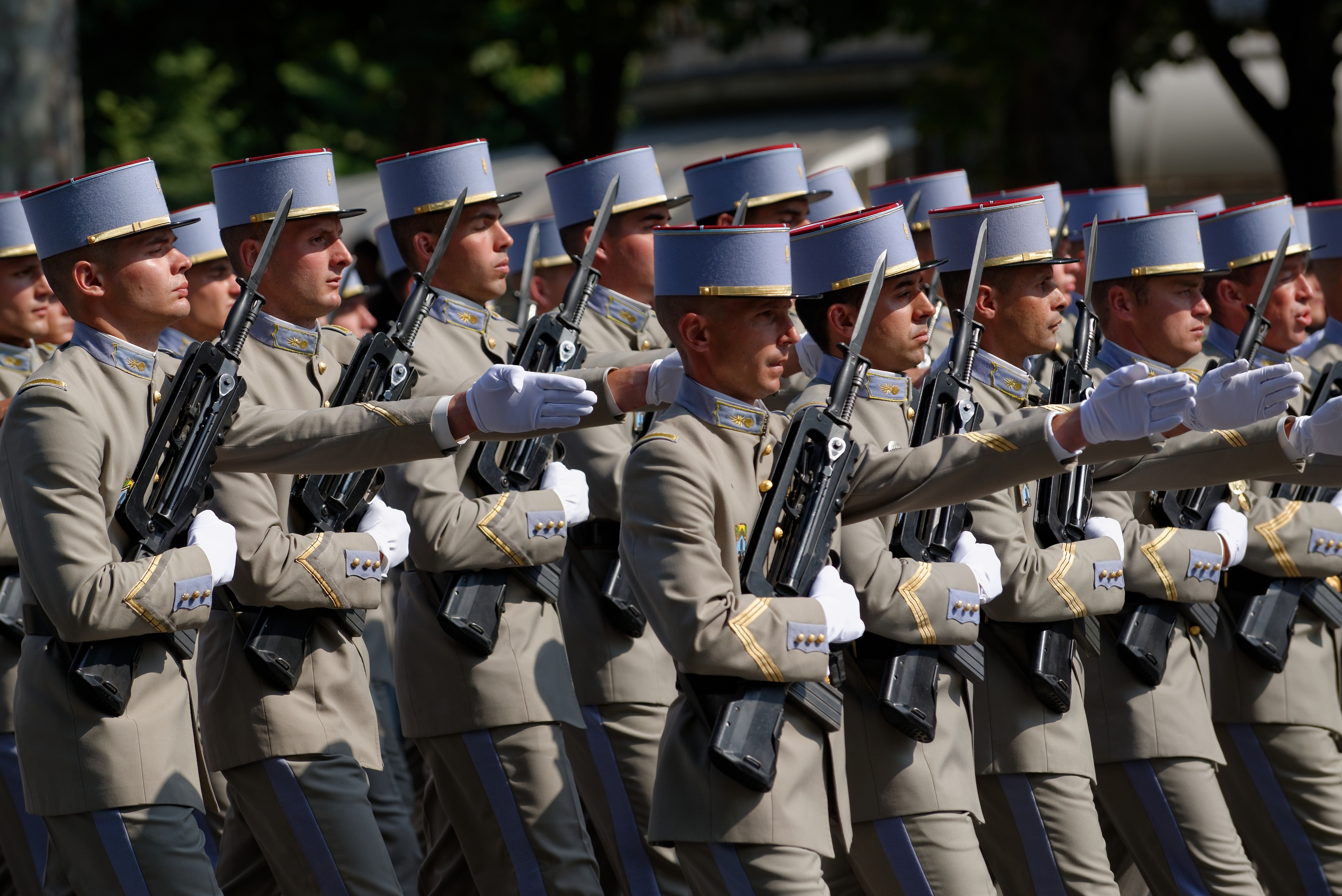
President Emmanuel Macron presided over France's annual Bastille Day military parade in Paris on Tuesday, July 14, 2026 [1].
The event served as a public demonstration of France's current military capabilities and its pursuit of strategic autonomy within Europe. By showcasing its hardware and personnel, the government aims to signal a broader "strategic awakening" for the continent [2].
The parade along the Champs-Élysées featured a significant mobilization of forces. Approximately 6,700 soldiers marched in the procession [1]. The aerial display included 98 aircraft [1] and 31 helicopters [1], while 315 ground vehicles participated in the maneuvers [1].
Beyond the national holiday, the event carried additional historical weight by marking the 400th anniversary of the French Navy [1]. This milestone highlighted the long-term evolution of France's maritime power and its role in global security.
A spokesperson for the Élysée Palace said the display represented "the rearmament of France and its strategic independence and the strategic awakening of Europe" [2].
This particular celebration was noted as the final time President Macron would oversee the annual military parade for the national holiday [2]. The scale of the event reflected the administration's focus on maintaining a visible military presence during a period of shifting geopolitical tensions.
“The parade featured approximately 6,700 soldiers, 98 aircraft, and 315 vehicles.”
The emphasis on 'strategic independence' and the scale of the 2024 parade suggest that France is positioning itself as the primary military leader in Europe. By linking the 400-year history of its navy with modern rearmament, the Macron administration is attempting to bridge historical prestige with a contemporary need for a self-reliant European defense architecture that is less dependent on non-EU allies.


