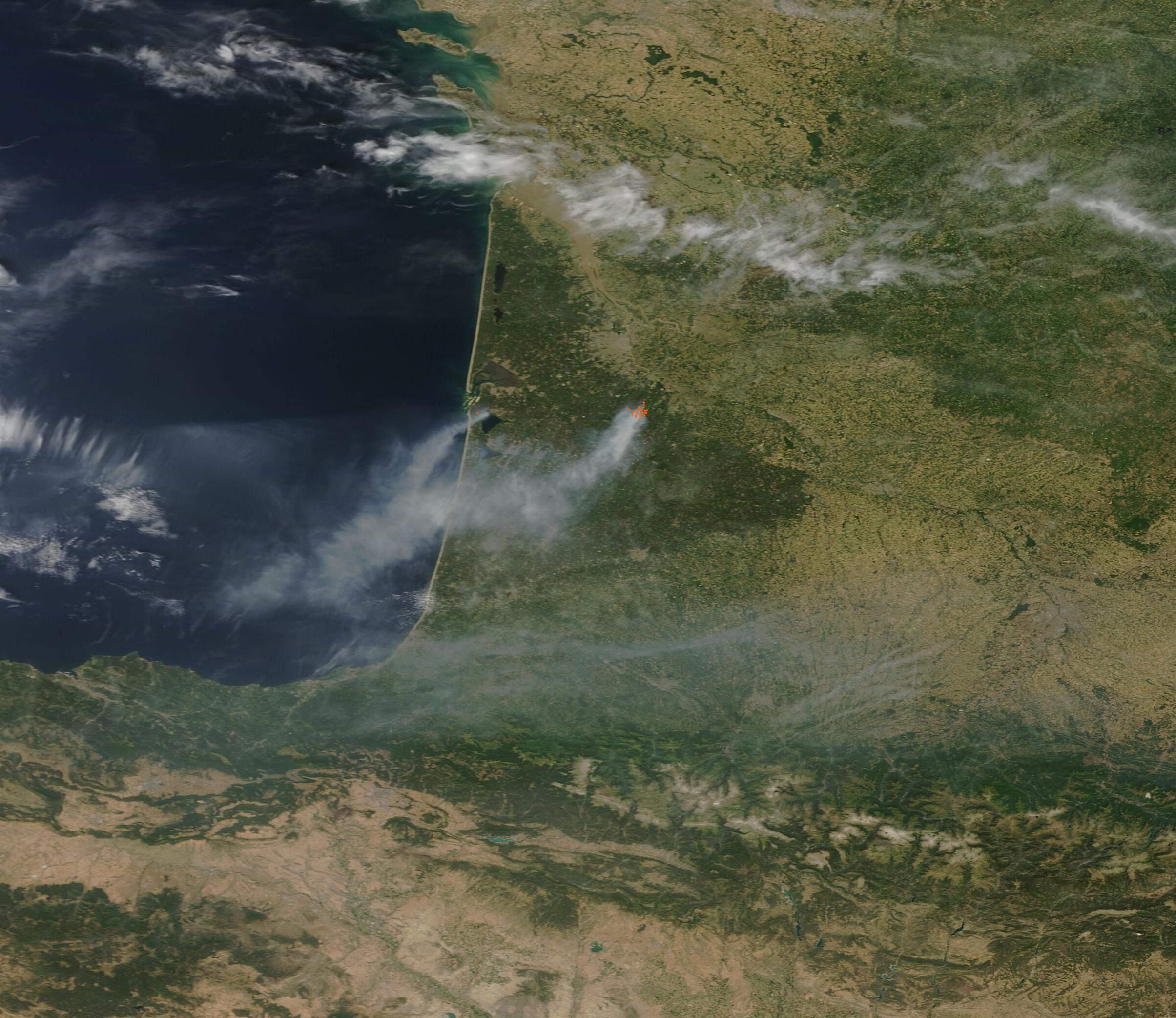
French firefighters are battling pyrocumulonimbus clouds for the first time in the country as wildfires rage near Bordeaux.
These "fire clouds" represent a dangerous escalation in wildfire behavior because they create their own weather systems. By generating localized thunderstorms, these clouds can produce lightning and erratic winds that ignite new fires and hinder emergency responses.
The blaze is located about nine miles from the outskirts of Bordeaux [1]. In less than four days, the fire has burned more than 162 square miles [2]. The intense heat from the wildfire creates strong updrafts that form the pyrocumulonimbus clouds, which then fuel the cycle of destruction.
The French interior minister said, "The Gironde wildfire has a life of its own and firefighters are facing an unprecedented situation."
Residents of the Gironde department and tourists visiting from the UK and other regions have been forced to flee. Some visitors described their holidays as having become evacuation missions, as they escaped what they described as a wall of flames.
Firefighters are grappling with the immense clouds as they attempt to contain the perimeter. Similar phenomena have been referenced in the Madrid region of Spain, but the appearance of such clouds in France marks a significant shift in the region's fire profile.
These clouds create a feedback loop where the fire generates the cloud, and the cloud—through lightning and wind—spreads the fire further. This makes traditional containment strategies more difficult to implement as the weather shifts rapidly over the blaze.
“The Gironde wildfire has a life of its own and firefighters are facing an unprecedented situation.”
The emergence of pyrocumulonimbus clouds in France indicates that wildfires in the region are reaching intensities previously seen in more arid climates like Australia or the Western U.S. When a fire becomes large enough to influence the atmosphere and create its own weather, it ceases to be a predictable terrestrial event and becomes a complex meteorological hazard, significantly increasing the risk to nearby urban centers like Bordeaux.


