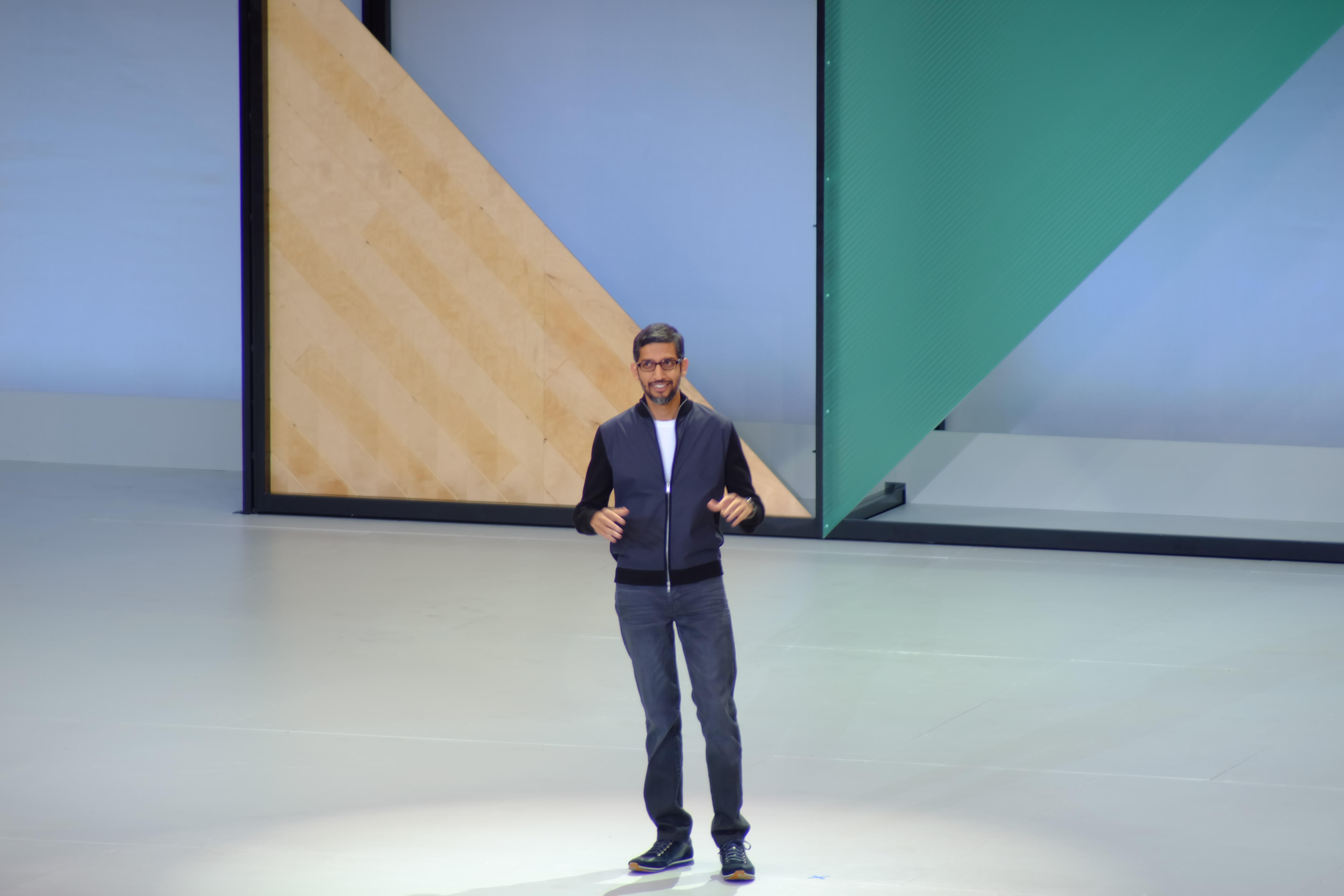
Google announced the new Gemini 3.5 family of AI models during its I/O 2026 keynote on Tuesday [1, 2].
The updates signal a deeper integration of generative AI across Google's ecosystem, positioning the company to compete in a rapidly evolving landscape of large language models.
CEO Sundar Pichai led the two-hour keynote [1] at the Shoreline Amphitheater in Mountain View, California [1]. The event focused on the company's AI-first strategy and featured updates across various applications and AI models [2, 3].
A central part of the announcement was the introduction of the Gemini 3.5 family [2]. As part of this rollout, Google set Gemini 3.5 Flash as the default model for both the Gemini app and the AI Mode in Search [3].
Staff from 9to5Google said the event began at 10 a.m. PT, 1 p.m. ET, and 5 p.m. GMT [1]. The presentation highlighted how these new models will streamline user experiences across the Google suite.
The Verge staff said the keynote was another AI-heavy presentation that focused on updates across its apps and AI models [2]. By transitioning to Gemini 3.5 Flash as the standard, Google aims to increase the speed and efficiency of AI responses for millions of users globally.
These developments follow a trend of rapid iteration in the AI sector, where model efficiency and integration into search engines have become primary battlegrounds for tech giants in the U.S.
“Google announced the new Gemini 3.5 family of AI models during its I/O 2026 keynote.”
The shift to Gemini 3.5 Flash as the default model suggests Google is prioritizing latency and efficiency over raw model size. By embedding these capabilities directly into Search and its primary AI app, Google is attempting to make generative AI a seamless utility rather than a separate tool, countering the rise of standalone AI search competitors.


