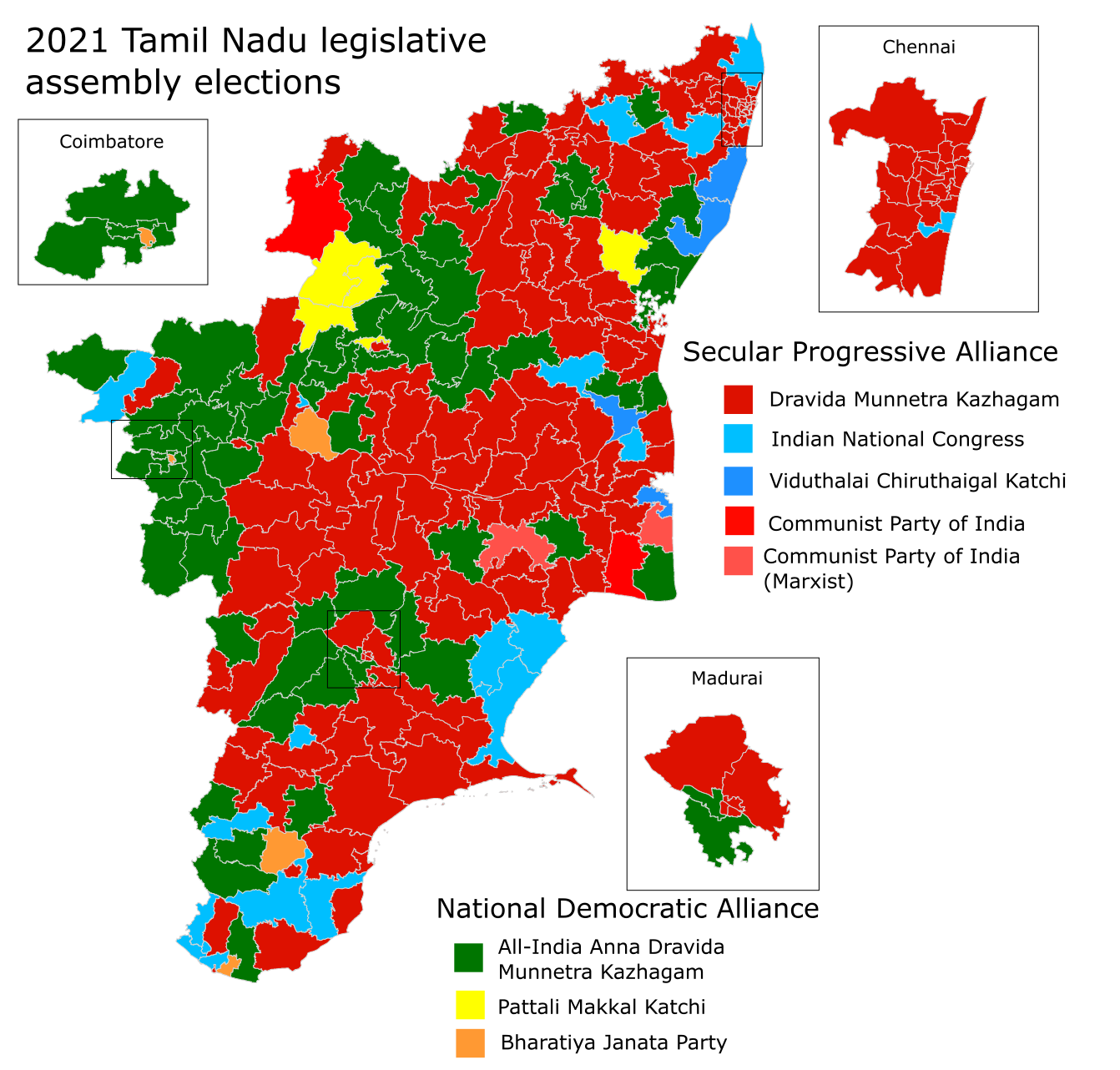
The Tamilaga Vettri Kazhagam (TVK) is attempting to form the government in Tamil Nadu following recent state elections [1].
This power struggle determines whether TVK leader Vijay can secure a stable majority to lead the state. The outcome depends on a pending agreement with the Viduthalai Chiruthaigal Katchi (VCK), whose support could finalize the government's legitimacy.
TVK has 107 MLAs supporting its government formation effort [3]. To solidify this position, the party is seeking a formal letter of support from the VCK. However, uncertainty remains as VCK cadres are demanding the Deputy Chief Minister post for their leader, Thol Thirumavalavan [2, 3].
Reports regarding the VCK's current position are contradictory. Some sources said that the CPI, CPI(M), and VCK have already extended support to the TVK, enabling the party to stake its claim [1]. Other reports said that Thol Thirumavalavan has not yet announced his party's official stance and was scheduled to do so following a key meeting [2].
TVK leader Vijay and MLA Busi Anand have been involved in the process, including meetings with the governor to discuss the formation of the administration [1]. The VCK's delayed announcement has deepened the uncertainty surrounding the timeline for the new government's swearing-in ceremony [3].
The tension centers on the distribution of power within the potential coalition. While TVK holds a significant number of seats, the VCK's demand for the Deputy Chief Minister portfolio represents a critical negotiation point that could either facilitate or block the transition of power [2, 3].
“TVK has 107 MLAs supporting its government formation effort”
The current deadlock highlights the precarious nature of coalition politics in Tamil Nadu. While the TVK holds a strong plurality of seats, the demand for a high-ranking portfolio like Deputy Chief Minister by the VCK suggests that the cost of a stable majority may be a significant share of executive power. Until a formal agreement on portfolios is reached, the government formation remains vulnerable to shifting political alliances.


