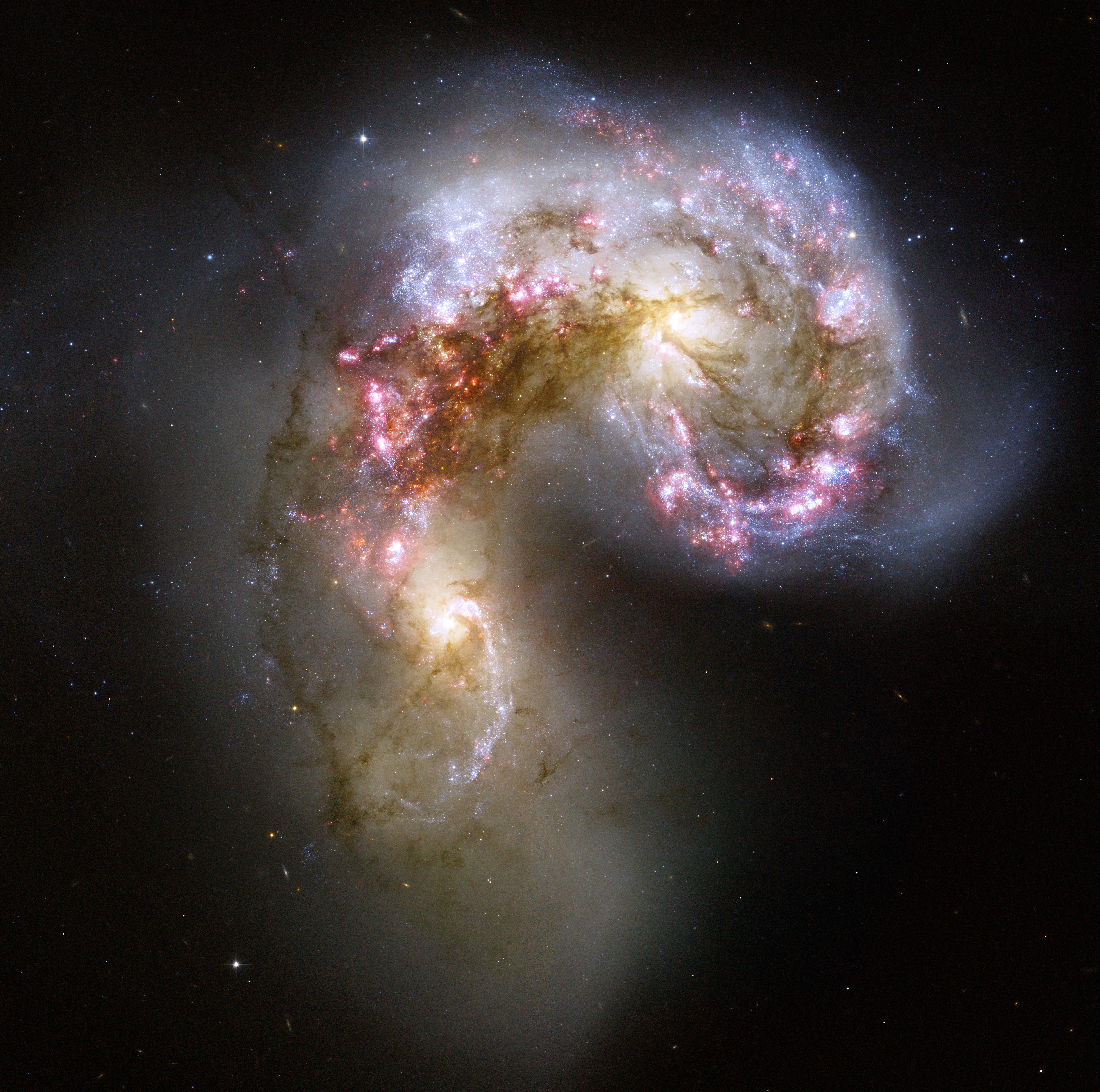
Astronomers have found evidence of a hidden supermassive black hole inside the colliding Antennae galaxies [1].
This discovery provides a rare glimpse into the violent processes of galactic mergers. Understanding how supermassive black holes behave during these collisions helps scientists determine how galaxies evolve and how the most massive objects in the universe grow.
The research focuses on the Antennae galaxies, known as NGC 4038 and NGC 4039 [1]. This pair of colliding galaxies is located approximately 70 million light-years from Earth [2]. The evidence for the black hole was detailed in a research paper posted to the arXiv pre-print server on May 21, 2026 [1].
To uncover the hidden object, the research team utilized a combination of high-energy observations. These included X-ray measurements and infrared data from the James Webb Space Telescope [3]. The data revealed signatures consistent with a massive black hole that has been obscured from view by the dense gas and dust typical of merging systems [3].
In the Antennae galaxies, the collision triggers intense bursts of star formation, which often creates a thick shroud of interstellar material. This material can block visible light, making the central black hole nearly impossible to detect with traditional optical telescopes. The use of infrared and X-ray technology allowed the team to peer through this debris, revealing the gravitational powerhouse at the core of the merging system [3].
While the black hole remains obscured, its presence is inferred from the way it interacts with the surrounding environment. The signatures detected are typical of supermassive black holes that consume vast amounts of matter, releasing energy that can be seen in the X-ray spectrum [3].
“Evidence of a hidden supermassive black hole inside the colliding Antennae galaxies”
The detection of an obscured supermassive black hole in the Antennae galaxies underscores the importance of multi-wavelength astronomy. By combining X-ray and infrared data, researchers can identify 'hidden' galactic nuclei that are invisible to optical telescopes, potentially revealing that supermassive black holes are more common in merging systems than previously recorded.